Aesthetics
Nylon has changeable aesthetics
that can be modified by choosing suitable fiber modifications, as well as yarn, fabric
structure, or fabric finishes. Because of its smoothness, lightweight, and high
strength, nylon has been very successful in hosiery and knitted fabrics
such as tricots and jerseys. The luster of nylon can be chosen depending on the
application it can be lustrous, semi-lustrous, or dull. The luster of trilobal
nylons is pleasing.
The drape of nylon fabrics can
vary greatly depending on the fiber and yarn size, as
well as the fabric structure is chosen. High-drape fabrics are used in
draperies, sheer lingerie overlays, and formalwear. Taffetas are stiff fabrics
that are used for formalwear, parkas, interiors, and technical applications.
Webbing for luggage handles and seat belts is an example of very stiff fabric.
Textures with smooth surfaces are
popular. Texture can be changed by using spun yarns or changing the structure
of the fabric. The filament yarn and compact structure are responsible for the
smooth hand associated with nylon fabrics. Textured-yarn fabrics are bulkier.
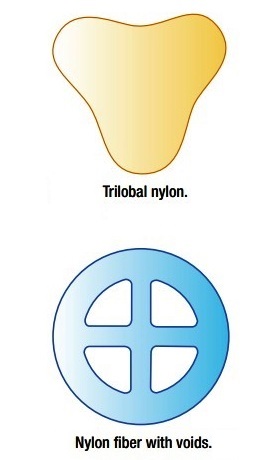
Nonround fibers are commonly used
in upholstery and carpets because round fibers magnify soil and appear dirty
quickly. Trilobal, pentalobal,
and voided fibers conceal soil even if the product is soiled, the soil is not
visible. Furthermore, the fibers' voids and flat sides scatter light, hide
soil, and closely mimic the matte luster of wool and other natural
fibers (see Figures 2).
Durability
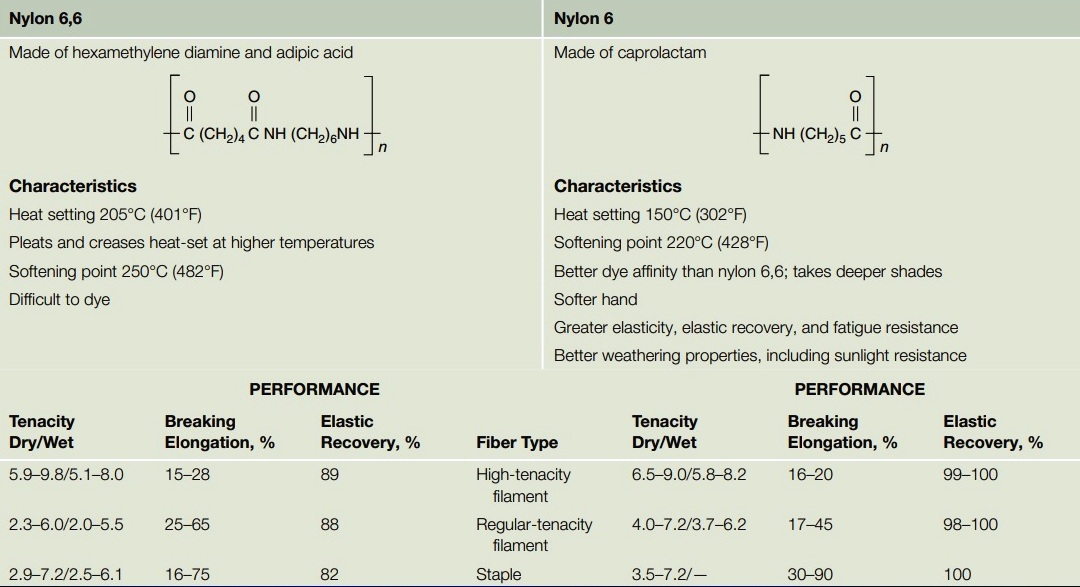
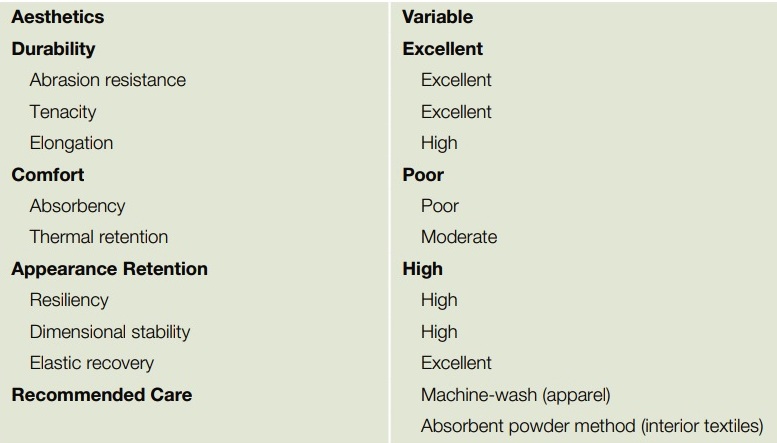
Nylon is highly durable. The
tenacity and abrasion resistance is outstanding. The degree of elongation is
high. High-tenacity fibers are used in seatbelts, ballistic fabric, tire cords,
and other technical applications. Fibers with regular tenacity and staples are
used in apparel and interior
textiles. High-tenacity (HT) fibers are stronger than regular-tenacity
fibers but have less elongation. High-tenacity fibers are drawn to a greater
extent than regular-tenacity fibers during production, making the HT fibers
more crystalline and oriented. High-strength nylon fibers are used in technical
products such as towropes, where high strength and low elongation are required.
Nylon has excellent abrasion
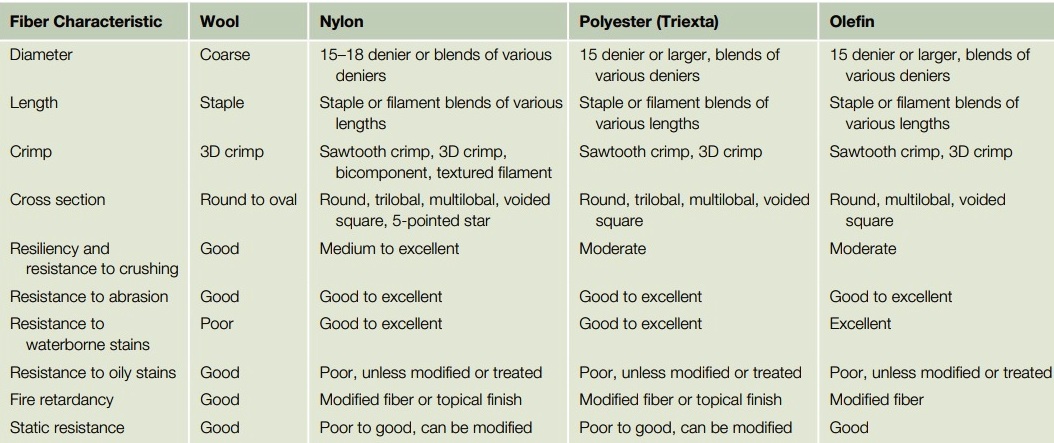
resistance in addition to excellent strength and elongation. Carpet is a common
application for nylon (Table 3). A good carpet is long-lasting, resilient, and
resistant to pilling, shedding, fading, traffic, abrasion, soil, and stains.
Many of these requirements are met or exceeded by nylon. Because of its
excellent durability and high resiliency, nylon is also prominent in pile
upholstery fabrics.
Because of these characteristics,
nylon is an excellent fiber for women's hosiery and tights. For pantyhose and
tights, no other fiber has been able to compete with nylon. Nylon's high
elongation and excellent elastic recovery account for its outstanding
performance in this application. Tights and hosiery have a high degree of
elongation; nylon recovers better than other fibers after high elongation.
Nylon can also be heat-set to keep its shape while being worn. Filament hosiery
develops runs when the fine yarns break and the knit loop no longer holds
together. Sheer hosiery is less long-lasting than opaque tights. Microfiber
nylon tights are warmer and softer than regular-sized apparel fiber tights.
Lining fabrics in some coats and
jackets are made of nylon. Nylon linings are more durable, but they are more
expensive due to the greater difficulty in sewing and higher costs when
compared to acetate fabrics. Nylon is not a long-lasting window treatment
fabric because it is weakened by sunlight. Sunlight- or ultraviolet-resistant
modified fibers are used in sheer curtains, draperies, car interiors,
seatbelts, and other high-exposure technical applications.
Comfort
Nylon is uncomfortably stiff. It
is not very absorbent. Despite having the highest absorbency of any synthetic
fiber (4.0 percent to 4.5 percent for nylon 6,6 and 2.8 percent to 5.0
percent for nylon 6), nylon is not as comfortable to wear as natural
fibers.
Compact filament nylon yarns were
initially used in woven
sports shirts for men. When wet from perspiration, the shirts became
transparent and felt clammy, especially in hot, humid weather. Textured and
spun yarns used in knit fabrics today result in more comfortable shirts. Knit nylon
fabrics are more comfortable than woven nylon
fabrics because heat and moisture escape more easily through the fabric's additional
air spaces. Polymer modifications make nylon clothing more comfortable. Thermal
underwear, actionwear, footwear, and accessories all use a hydrophilic fiber
with improved absorbency and wicking.
The same factors which make nylon
uncomfortable in one set of conditions make it convenient in another. Nylon has
low thermal conductivity. It's commonly used to make wind and water-resistant
jackets, parkas, tents, and umbrellas. The smooth, straight fibers pack tightly
together in yarns that can be woven into a
dense fabric with little space for wind or water to penetrate.
Another disadvantage of poor
absorbency is the generation of electrostatic discharge in low humidity due to
friction. Antistatic nylon modifications, antistatic finishes, or blends with
high-absorbency, low-static fibers can help to overcome this disadvantage.
Static electricity causes issues
with comfort, soiling, and use. Antistatic fiber and finish modifications are
common carpet modifications. To reduce static in carpets, small amounts of
metallic and carbon
fibers are sometimes used. Lining fabrics and slips are made with
antistatic nylon.
Nylon is one of the lightest
fibers on the market, with a specific gravity of 1.14.
In comparison to polyester,
nylon produces 21% more yardage per pound of fabric. This lighter weight
translates to lighter products and lower costs for transporting and finishing
fabrics. Nylon's lightweight and excellent durability make it ideal for
actionwear and sports gear.
Appearance Retention
Nylon fabrics have a high
appearance retention rating. Because of the heat-setting process, nylon is
extremely durable. Permanent pleats, creases, and engraved designs are all
created using the same method. Before being incorporated into the carpet, nylon
carpet yarns
are heat-set. Heat setting enhances the excellent compressional resiliency of
nylon fibers in pile yarns. Carpet
fibers' compressional resiliency is their ability to spring back to their
original height after being bent or otherwise deformed. Traffic lanes do not
form quickly. Furthermore, depressions caused by heavy furniture are less
likely to be permanent. Steaming these areas can help to reduce the appearance
of heavy furniture marks. Because higher-denier fibers have better
compressional resiliency and appearance retention, most carpet fibers are made
in a high denier, often 15 or greater.
Dimensional stability is
outstanding. Nylon resists shrinkage due to the heat setting and the fact that
the low-absorbency fiber is unaffected by water. Elastic recovery is fantastic.
Nylon recovers completely from 8% stretch; no other fiber does. It recovers 91
percent of its elongation at 16 percent elongation. Nylon is an excellent fiber
for hosiery, ski pants, swimsuits, tights, and other actionwear because of this
property. Nylon does not wrinkle easily, is stable, and has excellent elastic
recovery, so it maintains its appearance while in use.
For areas where fading,
particularly from exposure to sunlight, is a concern, solution-dyed and
sunlight-resistant carpet fibers are available. These carpets are designed
specifically for low-priced contract/commercial markets as well as automotive
interiors. Life vests, Flags, and other technical applications make use of
ultraviolet-resistant nylon fiber.
Care
Nylon clothing may be cleaned and
dried in the washing machine. The absorbent powder approach can be used to
clean interior fabrics. Nylon pioneered the notion of easy-care clothing.
During usage and care, nylon textiles maintain their look and form.
Nylon's wet strength is 80% to
90% of its dry strength. Wet elongation slightly increases. When nylon is wet,
it swells somewhat. Compare the swelling of various fibers: nylon, 14%; cotton, 40% to
45%; and viscose-rayon,
80% to 110 percent. These characteristics add significantly to nylon's
reputation as an easy-to-care-for material.
Warm wash water, mild agitation,
and gentle spin cycles are ideal for minimizing wrinkling. Some textiles may
wrinkle as a result of being washed in hot water. Hot wash water can cause
permanent wrinkles, but it can also help eliminate grease and oily stains.
Nylon is a color thief.
Colors from other textiles or dirt in the wash water are picked up by white and
light-colored nylon materials. A crimson sock that fades into the wash water of
a batch of whites may stain the white nylon materials, making them tough to
remove. The use of chlorine bleach over an extended period may cause white
nylon to yellow. By following proper laundry processes, you may avoid
discolored nylon as well as greyed or yellowed nylon.
Nylon dries fast because of its
limited absorbency. Short drying periods are required. Nylon is sensitive to
overdrying and dryers set on high heat. The melted and fused result of a nylon
garment dried in an overheated gas dryer with socks of varying fiber content is
shown in Figure 3.
Nylon is prone to static
electricity, especially when the air is dry, thus a fabric softener should be
used while cleaning. To avoid glazing, nylon should be pressed or ironed at a
low temperature of 270F to 300F. Home ironing temperatures are insufficient to
permanently press seams, creases, and pleats in clothes or to remove wrinkles
caused by washing.
Nylon's chemical resistance is
typically good. Nylon is resistant to alkali and chlorine bleaches, although it
is harmed by strong acids. Pollutants in the atmosphere can harm nylon or cause
issues with particular colors used
with nylon. When some acids are printed on
cloth, they produce a puckered look. Formic acid and phenol dissolve nylon.
Nylon is resistant to insect and
fungal attacks. Food soil on carpets, on the other hand, may attract insects.
Nylon has a low UV resistance. Bright fibers are more resistant to sunlight
than delustered fibers because the damaging energy is reflected rather than
absorbed. Nylon modifications that are resistant to sunlight are available.
Carpet soiling can be a major
issue. Carpet soiling is related to fiber cross-section, carpet color, and
fiber opacity/translucence. Soil is magnified in round cross-sections. Soil is
hidden by non-round cross-sections such as trilobal, pentalobal, and voided
(see Figures 2). Carpet fibers with soil-resistant modifications reduce soil
adherence and permanent staining. Furthermore, many carpets now incorporate
soil-resistant fiber modifications as well as soil-resistant finishes
Sustainability of Nylon
Nylon has a high resistance to
natural degradation and does not degrade quickly. It is resistant to mold,
mildew, rot, and a variety of chemicals. Although most nylon is susceptible to
sunlight damage, the damage does not occur quickly enough to minimize nylon
product disposal issues. Because nylon is made from petrochemicals, there are
concerns about the petrochemical industry's political, social, and
environmental impact: drilling in sensitive areas, pipelines and other
transportation issues, oil spills, the refinement and production of the
chemicals from which nylon is made, and the use and disposal of hazardous
chemicals. The manufacture of nylon requires more energy than the manufacture
of polyester
or cotton.
Nitrous oxide, a greenhouse gas, is emitted by nylon manufacturing plants.
To clean the fiber during the
processing of nylon from raw fiber to finished product, few, if any, chemicals
are used. This is because, unlike natural
fibers, nylon and other synthetic
fibers are not contaminated with soil and other materials such as leaf bits
during production. Because nylon is a melt-spun fiber, no chemical bath residue
must be rinsed from the fiber, and no solvents, such as those used with wet- or
dry-spun fibers, must be reclaimed. Furthermore, less water, salt, and acid are
used to dye the fiber. Excess dye from nylon fabrics is removed with less water
than some common dyes used on natural and regenerated cellulose fibers. Because
nylon fiber can be engineered for specific end uses, chemical finishes are
rarely required to improve consumer satisfaction with nylon products. As a
result, once nylon fiber is produced, further processing of nylon has a
negligible environmental impact.
Nylon is made from waste
materials from oil refineries. The raw materials for nylon were previously
considered waste products. Recycling nylon is a viable alternative to disposal.
The presence of other materials added to the melt in the production of the
original material, as well as the wide variety of nylon polymers on the market,
are two issues with recycling nylon.
A cost-effective commercial
carpet recycling program converts nylon carpet fiber into caprolactam (a nylon
6 raw material). Other recycling programs for nylon carpet fiber shave the
fiber from the surface of the carpet and mix it with plastic and concrete.
Recycled picnic tables and poured concrete foundations are made from lightweight
and durable composite materials of fiber and plastic or fiber and concrete.
Unfortunately, not all nylon carpet that is discarded is recycled. In some
cases, this is since a significant portion of the nylon used in carpet is
applied to olefin or other backing materials, which complicates recycling.
Because of the dye, declustering, and soil- and stain-resistant compounds
present in the most nylon carpet pile, the additives used to improve the
performance of nylon carpet make recycling more difficult.
Uses of Nylon
Nylon is one of the most widely
known fibers. Carpets are nylon's most important application. Tufted carpets
are an excellent end-use for nylon due to their aesthetically pleasing
appearance, durability, appearance retention, and ability to be cleaned in
place. The combination of nylon fiber and the tufting process results in
relatively low-cost and highly serviceable carpeting, which contributes to
carpeting's widespread use in both residential and commercial buildings.
A second important application
for nylon is in clothing. Nylon lingerie is appealing and long-lasting, with
good appearance retention and ease of care. Nylon is commonly used to make
panties, bras, nightgowns, pajamas, and lightweight robes.
Women's tights and sheer hosiery
are two important applications for nylon. No other fiber possesses the
combination of properties that makes it ideal for that application. Instead of
a heavier-denier yarn
or monofilament, very sheer hosiery is often 12 to 15 denier. Hosiery yarns can
be plain or textured, regular or microdenier in size, and monofilament or
multifilament stretch nylon.
Nylon is sometimes used to make
short or knee-high socks. They are frequently nylon blends with cotton or acrylic.
Nylon adds strength as well as stretch. Nylon is commonly used in the toe and
heel of socks to increase wear life. Other end uses for nylon include active
sportswear and actionwear where comfort stretch is important, as well as
leotards, tights, swimsuits, and ski wear. In cool and windy weather, nylon-taffeta
windbreakers and parkas are popular. Nylon can be used as a lining fabric for
jackets and coats.
Some performance nylon fibers
have been modified to have a cotton-like hand with improved pilling resistance,
and they are used in the inner layers of workwear, mountaineering apparel, and
hunting apparel. Other nylons for outdoor use and hunting apparel have been
altered to be stain- and tear-resistant, quiet (causing little rustling or
other noise that might frighten away game animals), quick-drying, and warm.
These fabrics
are used in the outer layers of workwear, as well as hunting and hiking
clothing. Supplex ™
is microfiber nylon that has been modified to be softer, suppler, and less
bulky than regular nylon, allowing for more freedom of movement in outerwear,
beachwear, and actionwear. Supplex ™ is
windproof, water repellent, breathable, and long-lasting.
Nylon has a wide range of
technical applications. Nylon is used for the tire cord that runs from rim to
rim over the curve of some radial tires, but polyester,
heat-resistant aramid, and steel are substituting nylon due to its flat-spot
tendency. Flat spotting happens after a car has been parked for a while and a
flattened spot forms on the tire. For the first mile or so, the ride is bumpy
as the tire recovers from flattening.
The average car consumes 25
pounds of fiber, the majority of which is most likely nylon. Upholstery fabric
(called body cloth), carpet for the interior, door and visor trims, trunk
lining, seatbelt webbing, and headliners on interior roofs are all examples of
car interiors that use nylon. Some are modified to be resistant to sunlight,
heat, or to have a high tenacity. Nylon is also used in clutch pads, brake
linings, yarns
for reinforcing radiator hoses and other hoses, and airbags.
Parachute fabric, glider tow
ropes, cords and harnesses, ropes and cordage, fishing nets, conveyor belts,
mail bags, consumer uses, webbings, leisure, and sporting goods fabric are
some of the other technical applications. Umbrellas, toothbrush and hairbrush
bristles, clotheslines, paintbrushes, and luggage are all examples of consumer
applications. Tents, spinnaker sails, fishing lines and nets, sleeping bags,
racket strings, backpacks, and duffle bags are examples of sporting goods. Soft
luggage, book bags, backpacks, camera bags, golf bags, hunting gear, and horse
blankets are examples of leisure goods.
Nylon microfibers are used in
clothing and interior design. These fibers are 26% to 36% softer than regular
nylon fibers and have a denier of 0.7 to 1.0 dpf, compared to a denier of 2.0
dpf for regular nylon. Micro nylons are used in a wide range of applications.
Water-repellent, wind- and wear-resistant, vapor-permeable, and comfortable
fibers. They are used in 100% nylon formations as well as blends with natural
fibers such as wool
and cotton
(Table 4).








.png)


